Frequently Asked
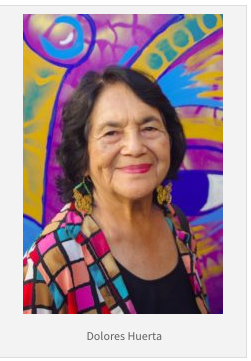
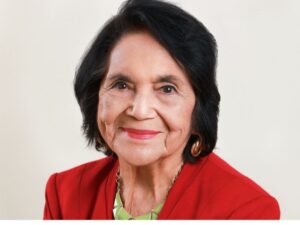
Dolores Huerta is a labor leader and community organizer. She has worked for civil rights and social justice for over 50 years. In 1962, Dolores Huerta co-founded the United Farm Workers union. She served as Vice President and played a critical role in many of the union’s accomplishments for four decades. She was the first Latina inducted into the National Women’s Hall of Fame, in 1993. In 2002, she received the Puffin/Nation $100,000 prize for Creative Citizenship which she used to establish the Dolores Huerta Foundation (DHF). She has received numerous awards: among them The Eleanor Roosevelt Humans Rights Award from President Clinton in 1998. In 2012 President Obama bestowed Dolores with The Presidential Medal of Freedom, the highest civilian honor in the United States. For more information, visit “About Dolores Huerta”.
Huerta was born on April 10, 1930, in the mining town of Dawson, New Mexico. She is the only daughter of Juan Fernández and Alicia Chávez. Her parents divorced when she was 3 and her mother, Alicia Chavez, moved the family to Stockton, California at 6 1/2.
Alicia Saint John Chavez was a strong, compassionate business woman that was active in community affairs, numerous civic organizations, She had a restaurant then opened a hotel with 70 rooms. She often helped people who needed shelter. Alicia encouraged the cultural diversity that was a natural part of Dolores’ upbringing in Stockton. Alicia’s community activism was reflected in Dolores’ involvement as a student at Stockton High School.
Juan Fernández was born in Dawson, New Mexico, a small mining town, to a Mexican immigrant family and worked as a coal miner. Later, he joined the migrant labor force, and harvested beets in Colorado, Nebraska, and Wyoming. When Huerta was a child she moved to Stockton, California, with her mother and siblings after her parents’ divorce. She remained in touch with her father, Juan Fernández, and took pride in his personal and professional development from coal miner to migrant laborer to union activist to an elected representative in the New Mexico state legislature to college graduate. and eventually earning a college degree.
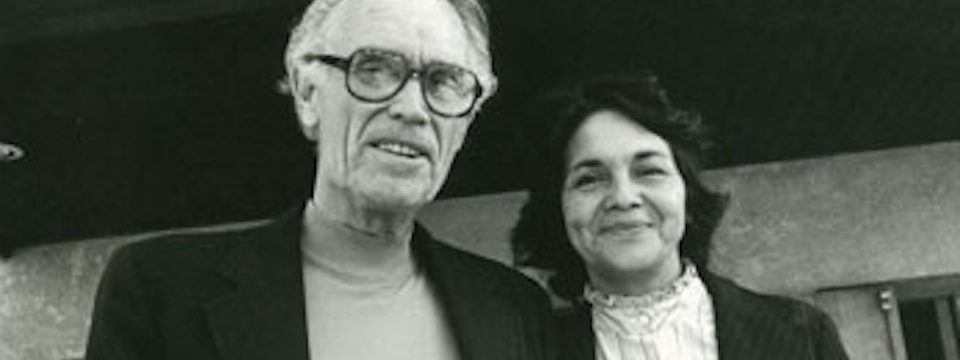
Huerta married Ralph Head in college. After divorcing Head, she married Ventura Huerta. She joined her life partner Richard Chávez in her early 40’s. They were life partners until his passing in 2011.
In high school, Dolores’ was active in numerous school clubs, was a majorette, and a dedicated member of the Girl Scouts until the age of 18. Upon graduating Dolores continued her education at the University of Pacific’s Delta College in Stockton earning a provisional teaching credential.
Dolores Huerta was inspired greatly by her compassionate and selfless mother, Alicia Chavez, who was very involved in charity work through the church, As a young girl she was greatly influenced by the guidance of her Girl Scout leader, Kathryn Kemp. She learned courage, confidence, basic survival skills, respect for nature, and developed leadership skills focused on making the world a better place. As a novice organizer, she was inspired by the organizing strategies and principles of Fred Ross Sr. Who she often refers to as the, “Gringo Godfather of the Farmworkers Movement!” Today, Ms. Huerta is fueled by the young activists of tomorrow. She is inspired by their fearlessness, motivation, determination and unwavering commitment to social justice.
As an advocate for human rights, Huerta has been arrested more than 25 times for participating in non-violent civil disobedience activities and strikes. In 1988, at age 58 Dolores suffered a life-threatening assault while protesting against the policies of then presidential candidate George Bush in San Francisco. A baton-wielding San Francisco SWAT police officer broke four ribs and shattered her spleen; later, in a lawsuit against SFPD they were forced to change their crowd control tactics.
During the 25-day fast in 1972 in Phoenix, Arizona, UFW’s co-founder Dolores Huerta used the slogan “!Sí, se puede!” (Yes, we can!) The workers felt that what was possible in California couldn’t be done in Arizona. Dolores responded with “Si Se Puede en Arizona” Since then this has been an influential rally cry and guiding principle that has served to inspire. The phrase is a federally registered trademark of the UFW. The phrase has been widely adopted by other movements and campaigns. It even made its way to the White House. President Obama thanked Dolores for letting him borrow his campaign slogan “Yes We Can!”.
While teaching, she could no longer bear to see her students come to school with empty stomachs and bare feet. After persistent efforts to provide them relief were unsupported by her administrators, she realized there was little she could do within the education system., Thus began her lifelong journey of working to fight for economic justice. Dolores Huerta decided to aid the children in her class by helping their farmworker parents win more equitable working conditions.
The Community Service Organization (founded 1947) was an important California Latino civil rights organization, most famous passing landmark legislation. It was founded in 1947 by Fred Ross, Antonio Rios and Edward Roybal and was a source of political support for Roybal during his long political career. Ross had been hired by Saul Alinsky and was employed by his Industrial Areas Foundation.
In 1955, Fred Ross helped Huerta found a Stockton Chapter of Community Service Organization (CSO). At the age of only 25, Huerta lobbied in Sacramento, California in support of a progressive legislation for old-age pensions for noncitizens, securing the right to register voters, and disability insurance for farmworkers.

In 1960, Huerta organized the Agricultural Workers Association. In 1962, she co-founded the National Farm Workers Association which eventually became the United Farm Workers of America, the first nationally recognized union for farm workers. She organized farm workers and led successful strikes and a worldwide boycott of California table grapes, pressuring growers to sign contracts guaranteeing better wages and working conditions for farm workers.
Dolores Huerta was a lead negotiator and secured historic union contracts improving wages and working conditions for farmworkers.
In the 1980s Huerta co-founded the UFW’s radio station and continued to speak and raise funds on behalf of a variety of causes, including immigration policy and farm laborers’ health. From 1988 to 1993, Huerta served on the U.S. Commission on Agricultural Workers, established by Congress to evaluate special worker provisions and labour markets in the agriculture industry. Huerta’s active engagement in lobbying for laws to improve the lives of farm lead to the following:
Led efforts to pass the following legislation:
- In 1960 California Bill that provided the DMV driver exam for Spanish-speaking persons.
- In 1962, repealed the Bracero Program as a key impediment to improving the wages of domestic farm workers.
- In 1963, the Aid to Families with Dependent Children (AFDC) legislation to extend the federal program to California farmworkers.
- The 1975, California Agricultural Labor Relations Act established the right to collective bargaining for farmworkers.
- In 1986, Immigration Reform and Control Act that legalized most undocumented immigrants who had arrived in the country prior to January 1, 1982.

In 1965, Huerta directed the UFW’s national grape boycott, taking the plight of the farm workers to the consumers around the world. The boycott resulted in the entire California table grape industry signing a three-year collective bargaining agreement with the UFW in 1970. This gave farmworkers better pay, benefits, and protections.
As coordinator of nationwide boycotts, Huerta helped lead the passage in 1975 of the Agricultural Labor Relations Act, the first law recognizing the rights of California farmworkers to bargain collectively.
Dolores Huerta Foundation was founded in 2003. In 2002, Dolores Huerta was awarded the Puffin Prize for Creative Citizenship for socially responsible leadership and courage. She was given $100,000 to spend however she liked. She decided to use this as seed money to found DHF. She, her daughters, and long time colleagues in the movement set out on a mission to create networks of healthy, organized communities pursuing social justice through systemic and structural transformation. 15 years later, DHF had grown to a team of over 40 staff members who work to inspire communities to build volunteer organizations empowered to pursue social justice.
Youth Program
The Dolores Huerta Foundation Youth Program comprises Liberated Youth for Empowerment (LYFE). This initiative aims to empower young individuals by providing tools and resources, fostering a critical understanding of history and systems of inequity. LYFE, with pathways in Civic Engagement, Transformational Art, and New Media and Technology, serves as an immersive leadership program, emphasizing the intersection of community engagement and health/wellness while amplifying the voices of future leaders. Upon graduating from LYFE, youth leaders transition as members of our alumni program, offering monthly programming, mentorship, scholarships, and entrepreneurship opportunities to support alumni in their journeys toward social justice and professional development.
Vecinos Unidos Chapters
Founded on the principle that self-determination and collective action are the catalysts for liberation, our organization centers its efforts on the leadership of grassroots community organizers. Utilizing a community organizing model developed by Fred Ross Sr., DHF organizers train, support, and mobilize historically disenfranchised communities to drive social change. Monthly community meetings, known as Juntas Generales, are hosted by organizers in each region, providing community members with training, resources, legislative information, and the tools to create action plans for structural and systemic changes in their community. These grassroots organizers collectively form Vecinos Unidos® (United Neighbors) chapters, currently active in active chapters in Lindsay, Woodlake, Wasco, and California City. Empowered through hands-on leadership training, community leaders in Vecinos Unidos® spearhead civic engagement campaigns, hold elected officials accountable and consistently achieve positive outcomes to address their community’s needs. With a 20-year history, Vecinos Unidos® members have successfully advocated for more parks, paved roads, pools, sewer connections, education equity, and various other impactful changes.
Civic Engagement
The Dolores Huerta Foundation develops natural leaders by providing hands-on civic engagement training and opportunities to raise awareness and advocate for progressive policies and reforms. Teams of volunteer and paid canvassers are regularly deployed for door-to-door canvassing, tabling, and phone banking in an effort to register and inform eligible voters, encourage robust participation in the electoral process, and promote awareness of legislative bills that can affect their communities.
To request the participation of Dolores Huerta, or another person affiliated with the Dolores Huerta Foundation, at an event please use the following link to complete the Event Request Form.
For media requests for Dolores Huerta and/or others affiliated with the Dolores Huerta Foundation please complete the Media Interview Request Form.
By attending a Dolores Huerta Foundation event you enter an area where photography, audio, and video recording may occur.
By entering the event premises or virtual environment, you consent to interview(s), photography, audio recording, video recording and its/their release, publication, exhibition, or reproduction to be used for news, web casts, promotional purposes, telecasts, advertising, inclusion on websites, or any other purpose by Dolores Huerta Foundation and its affiliates and representatives. You release Dolores Huerta Foundation, its officers and employees, and each and all persons involved from any liability connected with the taking, recording, digitizing, or publication of interviews, photographs, computer images, video and/or sound recordings.
By entering the event premises or virtual environment, you waive all rights you may have to any claims for payment, or royalties, in connection with any exhibition, streaming, webcasting, televising, or other publication of these materials, regardless of the purpose or sponsoring of such exhibiting, broadcasting, webcasting, or other publication irrespective of whether a fee for admission or sponsorship is charged. You also waive any right to inspect or approve any photo, video, or audio recording taken by Dolores Huerta Foundation or the person or entity designated to do so by Dolores Huerta Foundation.
You have been fully informed of your consent, waiver of liability, and release before entering the event.