
Dolores Huerta
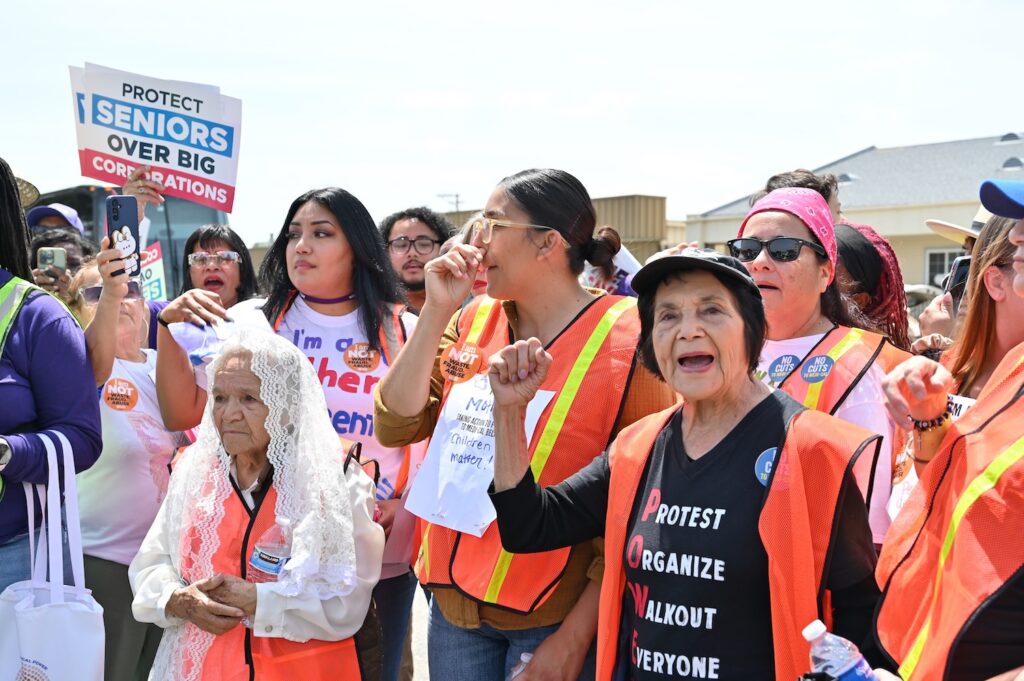
DHF Photo: Protest Against Medicaid Cuts, Feb. 2025
1930 — BIRTH IN DAWSON, NEW MEXICO
April 10, 1930: Dolores Clara Fernández is born in Dawson, New Mexico, to Alicia Chávez and Juan Fernández, a miner, labor activist, and future state legislator. Following her parents’ separation, Dolores grows up in Stockton, California.
Source: National Park Service — Dolores Huerta
EARLY 1950s — DOLORES BECOMES A TEACHER
1953: Dolores earns her teaching credential at Delta College in Stockton. Witnessing the poverty endured by farmworker children inspires her to leave teaching and dedicate her life to fighting for their farmworker families.
Source: California Community Colleges — Dolores Huerta
1955 — DOLORES BEGINS HER CAREER AS A COMMUNITY ORGANIZER
Working with Fred Ross Sr., Dolores helps establish Stockton’s Community Service Organization (CSO), organizing voter registration drives and pioneering grassroots campaigns for Latino civil rights, political representation, and economic opportunity.
Source: National Park Service — Dolores Huerta
1960 — DOLORES FOUNDS THE AGRICULTURAL WORKERS ASSOCIATION
Dolores establishes the Agricultural Workers Association (AWA) with Larry Itliong, one of her earliest efforts to organize farmworkers and fight for better working conditions, essential public services, and political representation.
Source: National Park Service — Dolores Huerta
1961–1963 — DOLORES WINS LANDMARK LEGISLATIVE PROTECTIONS FOR FARMWORKERS
Heading the CSO’s legislative program in Sacramento, Dolores successfully advocates for landmark measures expanding public assistance and disability protections for farmworkers. She lobbied and worked on legislation to extend the federal program, Aid to
Families with Dependent Children (AFDC), to California farmworkers, which would give medical aid to sick farmworker children. Her efforts also advanced Spanish-language driver’s license examinations and greater access to government services for Latino communities.
Sources: Library of Congress — Dolores Huerta | Dolores Huerta Foundation — Biography
1962 — DOLORES CO-FOUNDS THE NATIONAL FARM WORKERS ASSOCIATION
September 30, 1962: Dolores Huerta and César Chávez establish the National Farm Workers Association (NFWA), which will become the United Farm Workers. Together, they begin building a movement that will transform labor rights in American agriculture.
Source: Library of Congress — United Farm Workers Timeline
1963 — DOLORES BECOMES VICE PRESIDENT OF THE NFWA
January 21, 1963: Dolores is named one of three vice presidents, and the only woman, at the NFWA’s constitutional convention, becoming a pioneering woman leader in the emerging farmworker movement.
Source: Library of Congress — United Farm Workers Timeline
1964 — DOLORES MOVES TO DELANO
Dolores moves to Delano with her children, dedicating herself to building the NFWA. She emerges as one of the union’s most influential organizers, strategists, and contract negotiators.
Source: Farmworker Movement Documentation Project — Dolores Huerta
1965 — DOLORES HELPS LEAD THE HISTORIC DELANO GRAPE STRIKE
September 1965: Dolores advocates for the NFWA to join the strike launched by Filipino farmworkers, forging a historic alliance between Filipino and Mexican American agricultural workers. Their united struggle becomes one of the defining labor movements of the 20th century.
Sources: Smithsonian Institution — Dolores Huerta | National Park Service
1966 — DOLORES NEGOTIATES THE HISTORIC SCHENLEY CONTRACT
Dolores helps negotiate the landmark Schenley Wine Company agreement, one of the first major collective bargaining contracts won by the emerging farmworker union. The agreement establishes a historic precedent for farmworkers to negotiate wages, benefits, and working conditions with agricultural employers.
August 22, 1966: The NFWA and AWOC merge to form the United Farm Workers Organizing Committee (UFWOC), affiliated with the AFL-CIO.
Sources: Farmworker Movement Documentation Project | Library of Congress — UFW Timeline
1966–1970 — DOLORES PIONEERS LANDMARK PESTICIDE AND WORKPLACE PROTECTIONS
As a leading UFW negotiator, Dolores fights for higher wages, health benefits, and groundbreaking protections against hazardous pesticides, including DDT, aldrin, and dieldrin years before comparable federal prohibitions. Her efforts help establish pesticide safety as a critical issue in agricultural collective bargaining.
Sources: AFL-CIO — Dolores Huerta | Dolores Huerta on Pesticide Campaigns, 1997
1968 — DOLORES LEADS THE HISTORIC NEW YORK CITY GRAPE BOYCOTT
Dolores leads the New York City grape boycott, mobilizing labor unions, churches, students, and millions of consumers nationwide. Her campaign helps persuade A&P supermarkets to stop selling boycotted California grapes, building the economic pressure that leads to the UFW’s historic 1970 victories.
Sources: National Park Service — Dolores Huerta | Walter P. Reuther Library — Dolores Huerta Papers
1968 — DOLORES STANDS BESIDE ROBERT F. KENNEDY ON THE NIGHT OF HIS ASSASSINATION
June 5, 1968: Dolores stands near Robert F. Kennedy during his California presidential primary victory speech at the Ambassador Hotel in Los Angeles. Moments later, Kennedy is assassinated, and the farmworker movement loses one of its most influential political allies.
Source: Walter P. Reuther Library — Robert F. Kennedy and the UFW
1969 — DOLORES LEADS THE SAN FRANCISCO GRAPE BOYCOTT
Dolores directs the San Francisco grape boycott, targeting supermarket giant Safeway. Her organizing helps expand the nationwide consumer boycott into a powerful economic campaign that forces California grape growers toward the bargaining table.
Source: University of California Press — Beyond the Fields
1970 — DOLORES NEGOTIATES HISTORIC GRAPE GROWERS’ CONTRACTS
July 29, 1970: Giumarra Vineyards and 25 other Delano-area growers sign landmark UFW contracts. As a leading negotiator, Dolores helps secure union recognition, higher wages, health benefits, and workplace protections, bringing the nearly five-year Delano grape strike to a historic conclusion.
Sources: Walter P. Reuther Library — Giumarra Contract Signing | AFL-CIO — Dolores Huerta
1972 — DOLORES COINED “¡SÍ SE PUEDE!”
During a campaign against an Arizona law restricting farmworkers’ organizing rights, Dolores coins “¡Sí Se Puede!” — “Yes, We Can!” Her words become the UFW’s defining rallying cry and an enduring international symbol of hope, courage, and the power of collective action.
Source: National Park Service — Dolores Huerta’s House
1973 — DOLORES LEADS A RENEWED NATIONAL GRAPE BOYCOTT
When California growers sign contracts with the Teamsters, threatening the UFW’s hard-won victories, Dolores helps lead a renewed nationwide boycott, mobilizing consumers and organized labor to defend farmworkers’ right to choose their own union.
Source: AFL-CIO — Dolores Huerta
1973 — THE UNITED FARM WORKERS RECEIVES ITS HISTORIC AFL-CIO CHARTER
The UFW receives its independent AFL-CIO charter, establishing its place within the national labor movement. Dolores continues as vice president, championing collective bargaining, legislative protections, and political representation for farmworkers.
Source: Library of Congress — United Farm Workers History
1975 — DOLORES HELPS WIN THE LANDMARK CALIFORNIA AGRICULTURAL LABOR RELATIONS ACT
June 1975: Governor Jerry Brown signs the nation’s first comprehensive state law guaranteeing agricultural workers collective bargaining rights. Dolores’s years of organizing, boycotts, and political advocacy help secure this historic victory, establishing union elections and legal protections for California farmworkers.
Sources: Dolores Huerta Foundation — Biography | AFL-CIO — Dolores Huerta
LATE 1970s–EARLY 1980s — DOLORES EXPANDS FARMWORKERS’ POLITICAL POWER
As director of the UFW’s Citizenship Participation Day Department, Dolores champions landmark labor legislation, voter participation, and greater political representation for Latino and immigrant communities, extending the farmworker movement’s influence into government and electoral politics.
Source: Dolores Huerta Papers — Walter P. Reuther Library
1983 — RADIO CAMPESINA BRINGS FARMWORKERS THEIR OWN VOICE
May 1, 1983: The UFW launches Radio Campesina, bringing Spanish-language news, education, and information directly to farmworker families. Dolores supports the effort to empower agricultural communities through communication and access to information.
Source: Dolores Huerta Foundation — Biography and Achievements
1986 — DOLORES HELPS ADVANCE LANDMARK IMMIGRATION REFORM
November 6, 1986: President Ronald Reagan signs the Immigration Reform and Control Act. Dolores advocates for provisions creating a pathway to legal residency for hundreds of thousands of qualifying undocumented farmworkers, advancing one of the most consequential immigration reforms in modern American history.
Source: Library of Congress — Dolores Huerta
1986 — DOLORES CHAMPIONS THE “WRATH OF GRAPES” CAMPAIGN
Dolores helps lead the UFW’s renewed national grape boycott, exposing the dangers of pesticide poisoning and demanding stronger protections for farmworkers, their children, and consumers.
Sources: Los Angeles Times — January 8, 1986 | Dolores Huerta Papers — Walter P. Reuther Library
1988–1993 — DOLORES SERVES ON THE U.S. COMMISSION ON AGRICULTURAL WORKERS
Appointed to the congressionally established commission, Dolores helps examine farmworker wages, labor conditions, workforce needs, and the impact of federal immigration policy on American agriculture.
Source: Dolores Huerta Foundation — Biography
SEPTEMBER 14, 1988 — DOLORES IS BRUTALLY BEATEN BY SAN FRANCISCO POLICE
During a peaceful protest outside San Francisco’s St. Francis Hotel, police severely beat Dolores, breaking two ribs and rupturing her spleen. She survives emergency surgery and later secures an $825,000 settlement. Her case helps drive reforms in police crowd-control practices and accountability.
Sources: Los Angeles Times — September 16, 1988 | History.com — September 14, 1988
1992 — DOLORES CHAMPIONS A HISTORIC EXPANSION OF WOMEN’S POLITICAL POWER
During the landmark “Year of the Woman,” Dolores serves as Southwest Coordinator of the Feminist Majority’s Feminization of Power campaign, advancing women’s political leadership and representation, particularly among Latinas.
Source: Feminist Majority Foundation — The Feminist Chronicles, 1992
1993 — DOLORES IS INDUCTED INTO THE NATIONAL WOMEN’S HALL OF FAME
Dolores becomes the first Latina inducted into the National Women’s Hall of Fame, honoring her pioneering leadership in labor organizing, civil rights, and women’s equality.
Source: National Park Service — Dolores Huerta
1997 — MS. MAGAZINE HONORS DOLORES
Ms. magazine names Dolores one of its three most important women of 1997, recognizing her extraordinary leadership in labor rights, civil rights, and women’s empowerment.
Source: GBH — Dolores Huerta Biography
1998 — DOLORES RECEIVES THE ELEANOR ROOSEVELT HUMAN RIGHTS AWARD
President Bill Clinton presents Dolores with the Eleanor Roosevelt Award for Human Rights, honoring her lifetime of groundbreaking leadership in the struggle for justice and equality.
Source: AFL-CIO — Dolores Huerta
1999–2002 — DOLORES EXPANDS HER LIFE’S WORK BEYOND THE UFW
After decades of UFW leadership, Dolores expands her advocacy for women’s rights, immigrant rights, education, and political participation, laying the groundwork for a new grassroots movement.
Sources: AFL-CIO — Dolores Huerta | National Park Service — Dolores Huerta
2002 — DOLORES RECEIVES THE PUFFIN/NATION PRIZE FOR CREATIVE CITIZENSHIP
Dolores receives the prestigious $100,000 Puffin/Nation Prize, dedicating the award to establishing a foundation that will train grassroots leaders and empower underserved communities.
Source: Dolores Huerta Foundation — FAQ
2003 — DOLORES ESTABLISHES THE DOLORES HUERTA FOUNDATION
Dolores creates the Dolores Huerta Foundation (DHF), launching a new chapter of grassroots organizing dedicated to political empowerment, educational equity, economic justice, and community leadership throughout California’s Central Valley.
Source: Dolores Huerta Foundation — History
2004 — DOLORES HUERTA FOUNDATION EXPANDS VECINOS UNIDOS COMMUNITY ORGANIZING
The Foundation establishes Vecinos Unidos (“Neighbors United”) chapters in Lamont, Arvin, and Weedpatch, California, empowering residents to organize for better schools, essential public services, and improved neighborhood infrastructure.
Source: Fresno State — Dolores Huerta Foundation Community Needs Assessment
2006 — DOLORES HUERTA FOUNDATION CAMPAIGNS FOR FAIR WAGES
Through its “Sueldos Justos” (“Fair Wages”) campaign, Dolores and the Foundation organize farmworkers to demand higher wages, improved working conditions, and economic justice.
Source: Dolores Huerta Foundation
2007 — DOLORES HUERTA FOUNDATION CHALLENGES ANTI-IMMIGRANT POLICIES IN BAKERSFIELD
Dolores and the Foundation challenge restrictive immigration proposals in Bakersfield, defending immigrant rights, language access, and equal treatment under local government policies.
Source: California State University, Bakersfield — History of English-Only Policies
2008 — VECINOS UNIDOS WINS IMPROVEMENTS FOR UNDERSERVED COMMUNITIES
Through Vecinos Unidos, the Foundation mobilizes Kern County residents to fight for essential infrastructure, including millions of dollars of public funding for sidewalks, streetlights, sewers, parks, and improved public services.
Source: Dolores Huerta Foundation
2009–2010 — DOLORES HUERTA FOUNDATION ADVOCATES FOR HISTORIC HEALTHCARE REFORM
Dolores and the Foundation advocate for expanded healthcare access and federal reform, contributing to the national movement that culminates in the landmark Affordable Care Act, signed March 23, 2010.
Sources: Dolores Huerta Foundation | National Park Service — Dolores Huerta
2010 — DOLORES HUERTA FOUNDATION CHAMPIONS CENSUS PARTICIPATION AND REPRESENTATION
The Foundation organizes Census outreach to ensure historically undercounted farmworker and immigrant communities receive fair political representation and their share of essential public resources.
Source: Dolores Huerta Foundation
2012 — PRESIDENT OBAMA AWARDS DOLORES THE PRESIDENTIAL MEDAL OF FREEDOM
May 29, 2012: President Barack Obama awards Dolores the Presidential Medal of Freedom, the nation’s highest civilian honor, recognizing her historic contributions to labor rights, civil rights, and women’s equality. Obama acknowledges the inspiration he drew from her creation of “¡Sí Se Puede!”
Source: Dolores Huerta Foundation — Biography
2013 — DOLORES IS INDUCTED INTO THE CALIFORNIA HALL OF FAME
Dolores is inducted into the California Hall of Fame, honoring her extraordinary contributions to labor rights, civil rights, and California history.
Source: California Museum — Dolores Huerta
2014–2017 — DOLORES HUERTA FOUNDATION WINS A LANDMARK CIVIL RIGHTS SETTLEMENT
The Foundation challenges discriminatory suspension and expulsion practices in Kern County schools. July 24, 2017: A landmark legal settlement requires sweeping reforms to student discipline policies, advancing educational equity and students’ civil rights.
Sources: Kern High School District — Settlement Information | California Rural Legal Assistance — Settlement
2015 — DOLORES CONTINUES HER PIONEERING LEADERSHIP FOR WOMEN’S RIGHTS
As a board member of the Feminist Majority Foundation, Dolores champions women’s equality, reproductive rights, and greater political representation for women.
Source: Feminist Majority Foundation — Dolores Huerta
2020–2021 — DOLORES HUERTA FOUNDATION RESPONDS TO THE COVID-19 CRISIS
The Foundation mobilizes to protect farmworkers and vulnerable families, distributing food and protective equipment, providing public health education, and organizing vaccination outreach and educational assistance.
Source: Dolores Huerta Foundation — 2024 Impact Report
2018 – 2022 — DOLORES HUERTA FOUNDATION FIGHTS FOR FAIR POLITICAL REPRESENTATION
The Foundation challenges local and statewide inequitable electoral boundaries and champions voting-rights protections and redistricting that strengthens political representation of underserved communities.
Sources: Civil Rights Litigation Clearinghouse — DHF Voting Rights Case | Dolores Huerta Foundation
2023 — DOLORES HUERTA FOUNDATION EXPANDS EDUCATIONAL AND CAREER OPPORTUNITIES
The Foundation expands youth leadership, college readiness, and career programs, creating new opportunities for students from farmworker and underserved communities.
Source: Dolores Huerta Foundation
2024 — DOLORES HUERTA FOUNDATION BREAKS GROUND ON THE PEACE AND JUSTICE CULTURAL CENTER
The Foundation breaks ground on the $34.8 million Peace and Justice Cultural Center, envisioned as a permanent institution for community organizing, education, cultural preservation, and Dolores’s enduring mission.
Source: Dolores Huerta Foundation — 2024 Impact Report
OCTOBER 28, 2026 — DOLORES HUERTA DIES AT AGE 96
Dolores dies at her home in Bakersfield, surrounded by family. Her seven decades of pioneering leadership transformed American labor rights, civil rights, women’s equality, and grassroots organizing. Her extraordinary legacy lives on through generations inspired by her enduring words: “¡Sí Se Puede!”
Source: Dolores Huerta Foundation — Official Statement on Her Passing
2027 — THE DOLORES HUERTA PEACE AND JUSTICE CULTURAL CENTER IS PLANNED TO OPEN
The Foundation plans to open the Peace and Justice Cultural Center, preserving Dolores’s legacy and inspiring future generations of leaders.
Source: Dolores Huerta Foundation — Memorial and Legacy Statement
DOLORES HUERTA | APRIL 10, 1930 – OCTOBER 28, 2026
¡Sí Se Puede! — Yes, We Can!